Training library · Training module
Module 45
Safeguarding Children Training for Volunteers
A half-day training module for coordinators and staff who supervise volunteers working with children: types of abuse and harm outside the home, recognising signs, responding to a disclosure, recording and referring, the 2026 changes, safer recruitment and trustee duties.
Read: Regulated Activity Changes: What 1 September 2026 Means for Supervised Volunteers
On the platform: The Safeguarding section: who to tell, role check levels, a yearly health check and templates for recording concerns
Overview
For coordinators and staff who recruit, supervise and support volunteers working with children and young people in clubs, sport, faith groups, tutoring, mentoring and holiday schemes. Participants agree what safeguarding children means using the Working Together to Safeguard Children 2026 definition, then work in small groups on the types of abuse and harm, including child sexual abuse, exploitation, county lines and harm outside the home. Scenarios help them recognise signs and understand why children often do not tell. After the break they practise responding to a disclosure in trios, rewrite a poor record into facts, and learn the safeguarding lead route, local thresholds, the LADO and lawful information sharing. The trainer then sets out the 2026 changes accurately: Working Together 2026, the mandatory reporting duty that is law but not yet in force, and regulated activity after the supervision exemption was removed on 1 September 2026. Groups decide which roles are regulated activity and what checks fit, and the session closes with trustee responsibilities, serious incident reporting and the duty to refer to the DBS. Five extension activities cover online harm, faith and sports settings, learning from case reviews, crisis scenarios and a safeguarding culture audit.
What participants will learn
By the end of the session participants will be able to:
- explain what safeguarding children means in 2026, using the Working Together to Safeguard Children 2026 definition
- name the main types of abuse and harm, including child sexual abuse, exploitation and harm outside the home
- recognise possible signs of harm and the barriers that stop children telling
- respond to a disclosure, record facts and use the safeguarding lead route the same day
- describe the 2026 changes accurately, including what is not yet in force
- apply safer recruitment to roles with children, including role design and the handling of criminal record information
- outline trustee responsibilities, serious incident reporting and the duty to refer to the DBS
What’s included
- Trainer guide with session timetable, 9 timed activities, 5 extension activities, the 2026 legal context and trainer notes
- Facilitator slides (editable PowerPoint, 59 slides) with speaker notes
- 11 handouts (H1 to H11), including responding to a disclosure, recording and referring, the 2026 changes at a glance, regulated activity and checks from 1 September 2026, safer recruitment, trustee duties and a four-nations quick reference
- 6 worksheets (W1 to W6), including a disclosure practice observer sheet, a rewrite-the-record exercise, an ‘Is this regulated activity?’ decision sheet and a safeguarding culture audit
- 6 ‘What would you do?’ scenario cards (CS1 to CS6)
- Self-study course (10 modules, about 3 hours) and self-study slides for individual learners
- Evaluation form
What’s inside
Every page of every part, zoomed out so you can see the scale and layout: 270 pages in all.
 Trainer guide84 pagesHow to run the session: preparation, timings, what to say, activities and trainer hints
 Handouts and worksheets27 pagesFacts, guides, worksheets, scenario cards and templates for participants
 Facilitator slides59 pagesEditable presentation that follows the trainer guide
 Self-study course36 pagesThe same learning for volunteers who can’t attend, with knowledge checks
 Self-study slides62 pagesThe self-study course as slides, on any screen
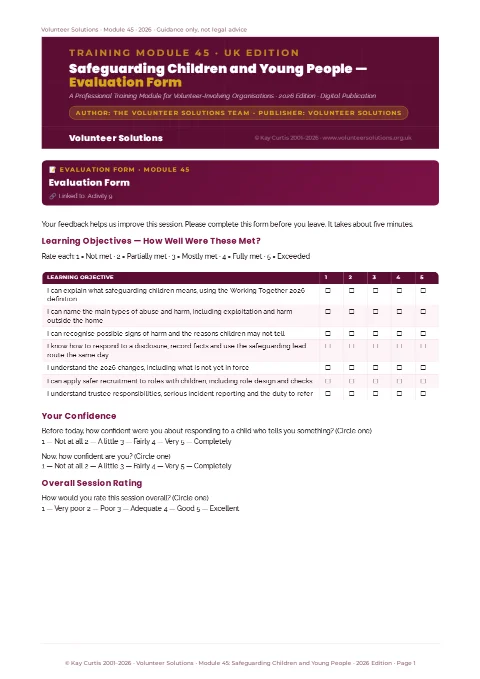 Evaluation form2 pagesParticipant feedback for your records and funders
Previews are shown at low resolution. The full files come with your plan or single purchase.
Deliver it yourselves, in-house
Everything your team needs to run this session without an external trainer: a scripted trainer guide, editable PowerPoint slides you can adapt with your own examples, the whole module in your logo and colours, and handouts ready to print. Kept up to date when the law or guidance changes, and it builds your team’s skills and confidence as they use it.
Why safeguarding children training matters for volunteer-involving organisations in 2026.
Module 45: Safeguarding Children and Young People is a half-day, trainer-led session of about three hours for the coordinators and staff who recruit and supervise volunteers working with children. It moves from understanding (what safeguarding means, types of harm, recognising signs) to skills (responding to a disclosure, recording and referring) to organisational responsibility (the 2026 changes, safer recruitment and trustee duties).
2026 brought significant change. Working Together to Safeguard Children 2026 replaced the 2023 edition in March. From 1 September 2026 the supervision exemption was removed, so supervised volunteers who teach, train, care for or supervise children frequently or overnight can now be in regulated activity in England, Wales and Northern Ireland. The module explains that this makes checks available, and that the organisation decides whether a check is appropriate.
The mandatory reporting duty in the Crime and Policing Act 2026 is law but not yet in force, and will apply in England only. The module teaches what it will require and keeps the rule for volunteers simple: tell your safeguarding lead straight away, and always the same day. Differences in Scotland, Wales and Northern Ireland, including PVG scheme membership in Scotland, are set out in a four-nations handout.
The legal content is awareness-level guidance, not legal advice, and is accurate as at 19 November 2026. It pairs with Module 16: Adult Safeguarding, which uses the same session pattern, and with Module 18: Youth Volunteering where your volunteers are themselves under 18.
Content last reviewed: November 2026. Written by the Volunteer Solutions team.
Questions
Who is this module for?
Coordinators and staff who recruit, supervise and support volunteers working with children and young people, and the trainers and safeguarding leads who prepare them. Trustees and safeguarding leads can join the same session: Activity 8 covers what the board must know and do.
Does it cover the change to regulated activity on 1 September 2026?
Yes. Activity 6 explains the removal of the supervision exemption and Activity 7 uses a decision sheet to work out which roles are now regulated activity. H7 sets out regulated activity and checks from 1 September 2026, including how checks for these roles are available and the organisation decides whether to request one.
Does it cover the mandatory reporting duty?
Yes, as a change that is law but not yet in force. The module explains who the duty will cover and what it will require, and asks trainers to check the current position before each delivery and update Activity 6 if the duty has started.
Does it work outside England?
Yes. H10 is a four-nations quick reference covering England, Wales, Scotland and Northern Ireland, including PVG scheme membership in Scotland and AccessNI checks in Northern Ireland. The trainer guide flags where the rules differ.
Can we run it in less than half a day?
Yes. The trainer guide suggests keeping Activities 4, 5 and 6 (responding, recording and the 2026 changes) if you are short of time, or running Activities 6 to 8 on their own as a 2026 update for experienced coordinators. The five extension activities can turn it into a full day.
Often used with
Try the platform free for 14 days
Try the main tools with up to 2 people. If you decide it is not for you, that is fine.
Not ready yet? Get free resources first