Training library · Training module
Module 24
Volunteer Risk Assessment Training Module
A training module for volunteer managers on identifying, assessing and reducing the risks volunteers face in any role, using the HSE five-step framework, positive risk-taking, and practical tools including a risk register and incident report form.
Overview
This training module helps volunteer managers, coordinators and trustees identify and manage the risks volunteers face, whatever their role. Participants look at what risk means today, including physical, digital, psychological, AI-related and reputational risks, and use risk scenario cards to identify hazards and assess likelihood and impact with the HSE five-step framework adapted for volunteering. They explore positive risk-taking, so that decisions enable volunteering rather than simply prevent risk. The legal input covers health and safety law, insurance, safeguarding, the Worker Protection Act 2023, UK GDPR and whistleblowing. Further activities cover digital and psychological safety, lone and remote working, incident and near-miss reporting, and shared responsibility. Participants leave with a risk assessment worksheet, a volunteer risk register template, an incident report form and a personal action plan.
What participants will learn
By the end of the session participants will:
- be able to identify risks across physical, digital, psychological, AI-related and reputational areas
- have used the HSE five-step risk assessment model, adapted for volunteering
- have practical strategies to reduce, minimise or transfer risk
- be aware of the key legal frameworks, including the Health and Safety at Work Act 1974, the Worker Protection Act 2023, the Equality Act 2010, UK GDPR, the Care Act 2014 and the Online Safety Act 2023
- know how to identify and respond to safeguarding concerns for children and adults, including DBS requirements and referral routes
- be able to apply positive risk-taking to make supported, proportionate decisions
- have discussed the shared responsibility of the organisation, the coordinator and the volunteer for safety
- have practical tools: a risk register template, an incident reporting framework and an action plan
- know where to find further guidance and specialist advice
What’s included
- Trainer guide with session timetable, timed activities and trainer notes
- Facilitator slides (editable PowerPoint) with speaker notes
- 12 handouts (H1 to H12)
- 4 worksheets (W1 to W4): risk assessment worksheet, volunteer risk register template, incident and near-miss report form, and action plan
- 12 risk scenario cards (RS1) and 8 volunteer role risk cards (VR1)
- 4 extension activities
- Self-study course and self-study slides for individual learners
- Evaluation form (W5)
What’s inside
Every page of every part, zoomed out so you can see the scale and layout: 273 pages in all.
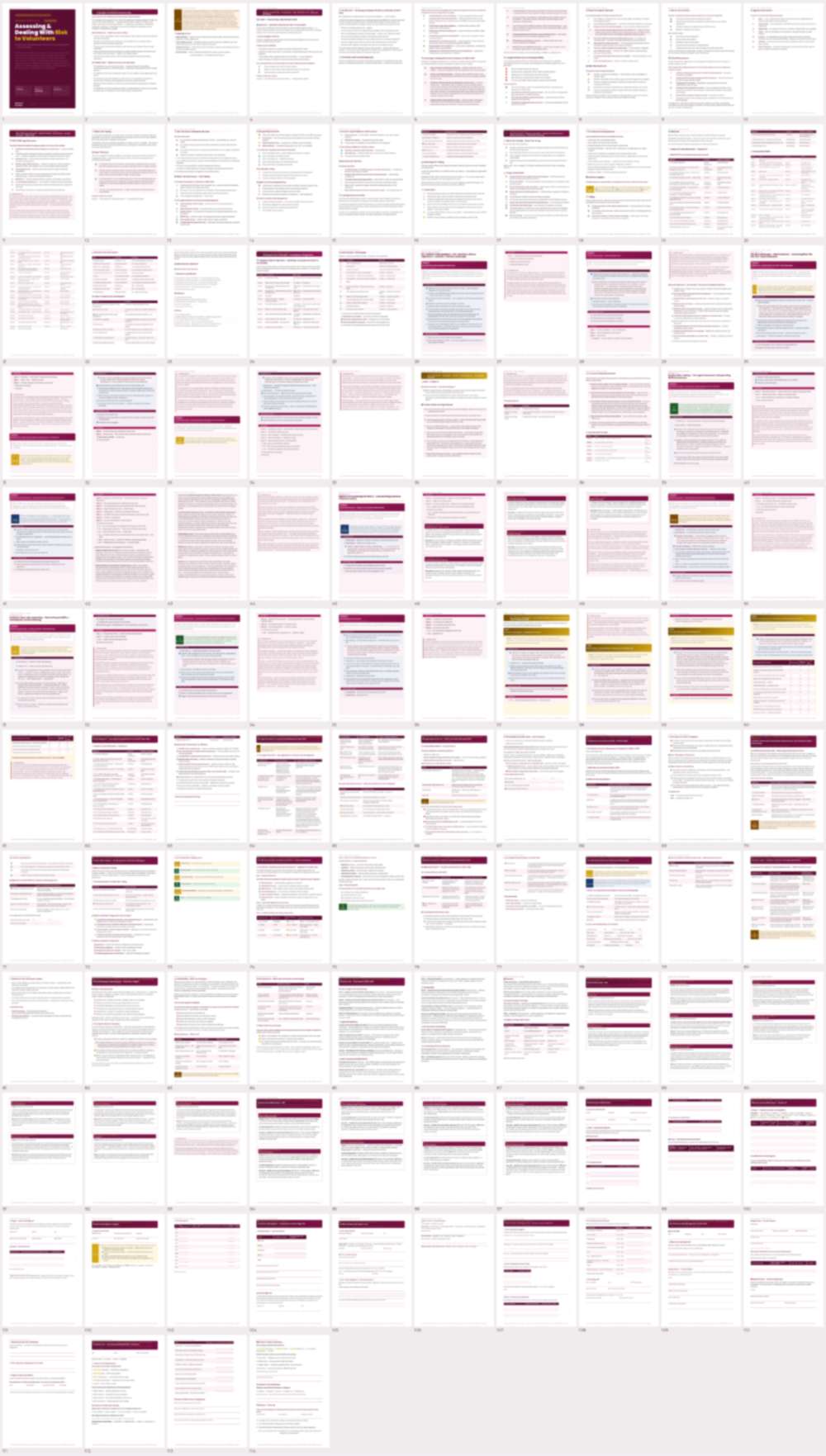 Trainer guide114 pagesHow to run the session: preparation, timings, what to say, activities and trainer hints
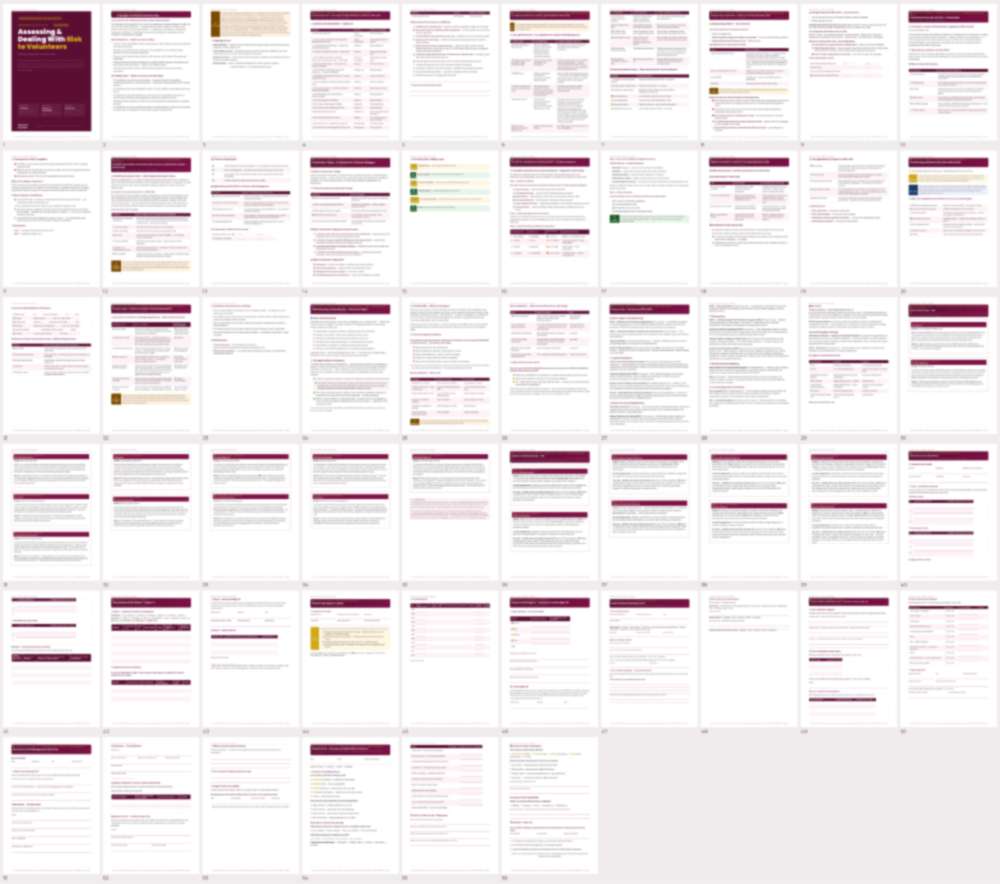 Handouts and worksheets56 pagesFacts, guides, worksheets, scenario cards and templates for participants
 Facilitator slides14 pagesEditable presentation that follows the trainer guide
 Self-study course29 pagesThe same learning for volunteers who can’t attend, with knowledge checks
 Self-study slides57 pagesThe self-study course as slides, on any screen
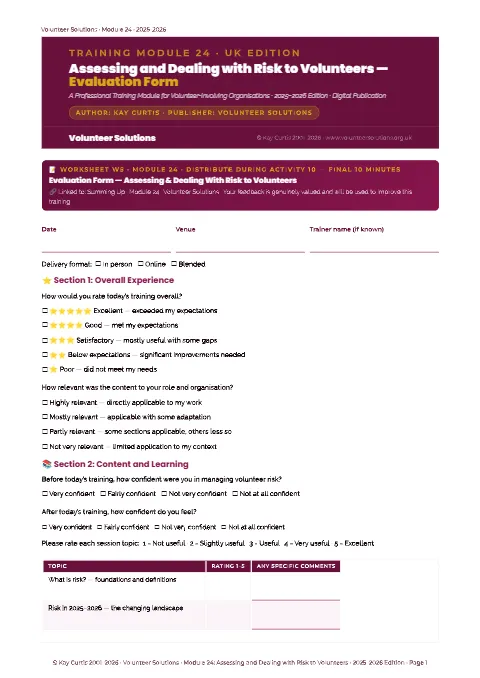 Evaluation form3 pagesParticipant feedback for your records and funders
Previews are shown at low resolution. The full files come with your plan or single purchase.
Deliver it yourselves, in-house
Everything your team needs to run this session without an external trainer: a scripted trainer guide, editable PowerPoint slides you can adapt with your own examples, the whole module in your logo and colours, and handouts ready to print. Kept up to date when the law or guidance changes, and it builds your team’s skills and confidence as they use it.
Why volunteer risk assessment training matters for UK charities in 2026.
Module 24: Assessing and Dealing with Risk to Volunteers is a half-day trainer-led session for volunteer managers, coordinators, staff and trustees responsible for volunteer safety.
It uses the HSE five-step framework, adapted for volunteering, and a positive risk-taking approach, so that risk is managed proportionately rather than avoided altogether.
Participants leave with practical tools they can use straight away: a risk assessment worksheet, a volunteer risk register template, an incident and near-miss report form and a personal action plan.
Try the platform free for 14 days
Try the main tools with up to 2 people. If you decide it is not for you, that is fine.
Not ready yet? Get free resources first