Training library · Training module
Module 33
AI Training for Charities & Volunteers
A full-day training module on using AI and digital tools safely in volunteering: how AI works, hallucination and bias, data protection under UK GDPR and the Data (Use and Access) Act 2025, prompt skills, deepfakes and AI fraud, and what an organisational AI policy should contain.
Overview
For any volunteer who uses digital tools in their role, and for the coordinators and trustees who make decisions about AI. No technical knowledge is assumed. Participants start with a team quiz on what they already know about AI, then get a plain-language explanation of how AI language tools work, with a live demonstration of hallucination. They map where AI could help or cause problems in their own role and analyse four illustrative charity case studies on accuracy, data protection, safeguarding and bias. After lunch, the trainer explains how UK GDPR and the Data (Use and Access) Act 2025 apply to AI tools, including why a personal AI account gives the organisation no Data Processing Agreement, and participants assess five scenarios. A supervised hands-on session covers prompt skills, checking AI output and switching off model training in personal accounts. The final part covers deepfakes, voice cloning and AI fraud, social media boundaries and the Online Safety Act 2023, drafting principles for an organisational AI policy, and personal digital commitments. Four optional extension activities cover running an AI awareness session for your team, evaluating AI tools, AI and accessibility, and the ethics of AI in charities.
What participants will learn
By the end of the session participants will:
- understand what AI language tools are and how they work, including hallucination and bias
- be able to write better prompts to get safer, more accurate and more useful AI outputs
- know how UK GDPR and the Data (Use and Access) Act 2025 apply to using AI tools
- understand the AI-powered fraud risks in 2026, including deepfakes, voice cloning and AI phishing
- be able to use AI tools responsibly and apply appropriate safety checks in their volunteer role
- know what an AI policy should contain and be able to make the case for one in their organisation
- have clear personal commitments about how they will use digital tools safely
What’s included
- Trainer guide with session timetable, an opening quiz and 8 timed activities, and trainer notes
- Facilitator slides (editable PowerPoint, 50 slides) with speaker notes
- 7 handouts (H1 to H7), including a pre-course questionnaire, a data protection and AI reference card, an online safety reference card, an AI policy framework template and a practical guide to AI tools
- 5 worksheets (W1 to W5), including an AI quiz sheet, an AI in my role mapping worksheet, a practical AI tasks sheet and a digital commitments action plan
- 4 charity case study cards (CS1 to CS4)
- 4 extension activities
- Self-study course (10 modules, about 2.5 to 3 hours) and self-study slides for individual learners
- Evaluation form
What’s inside
Every page of every part, zoomed out so you can see the scale and layout: 242 pages in all.
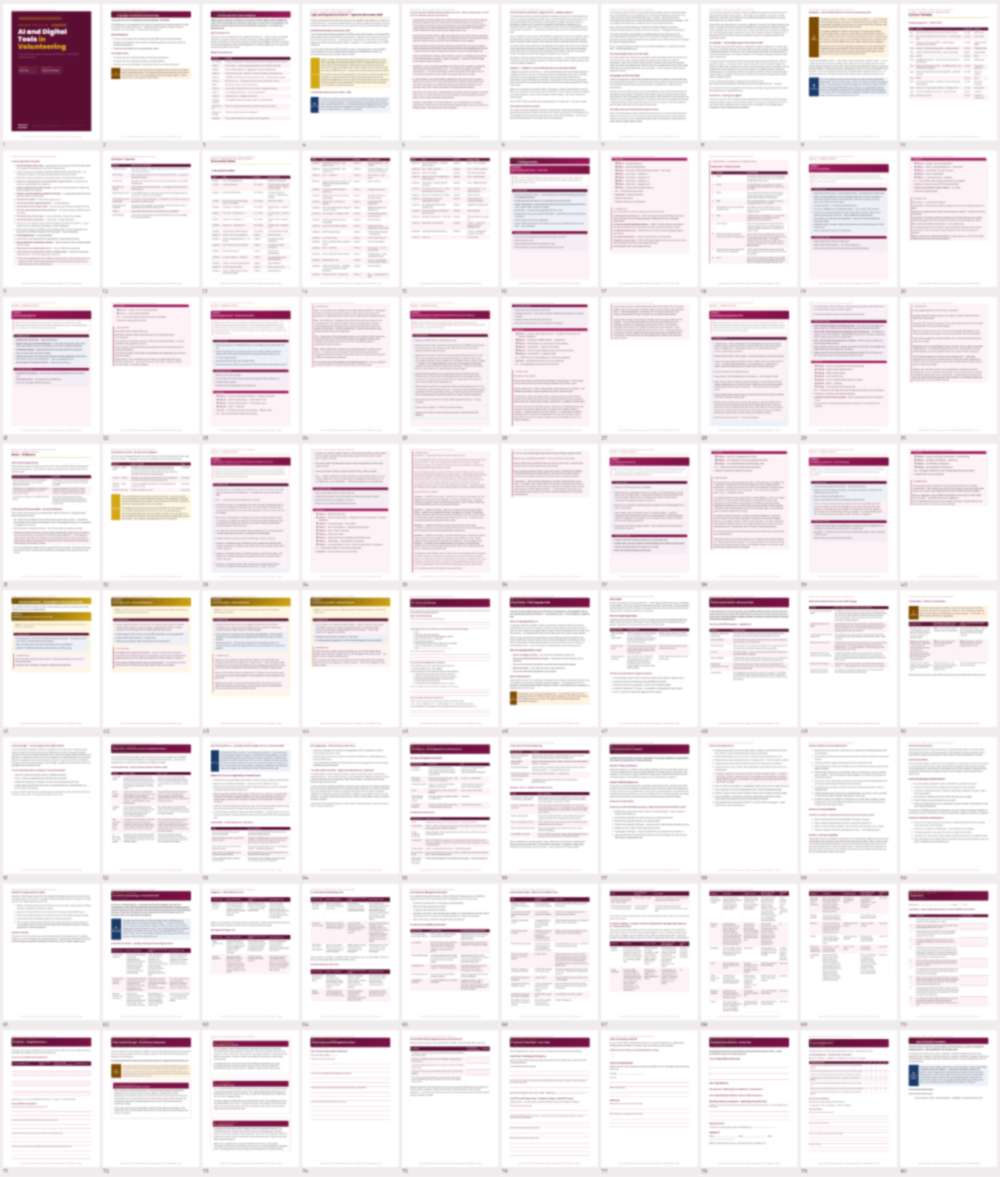 Trainer guide80 pagesHow to run the session: preparation, timings, what to say, activities and trainer hints
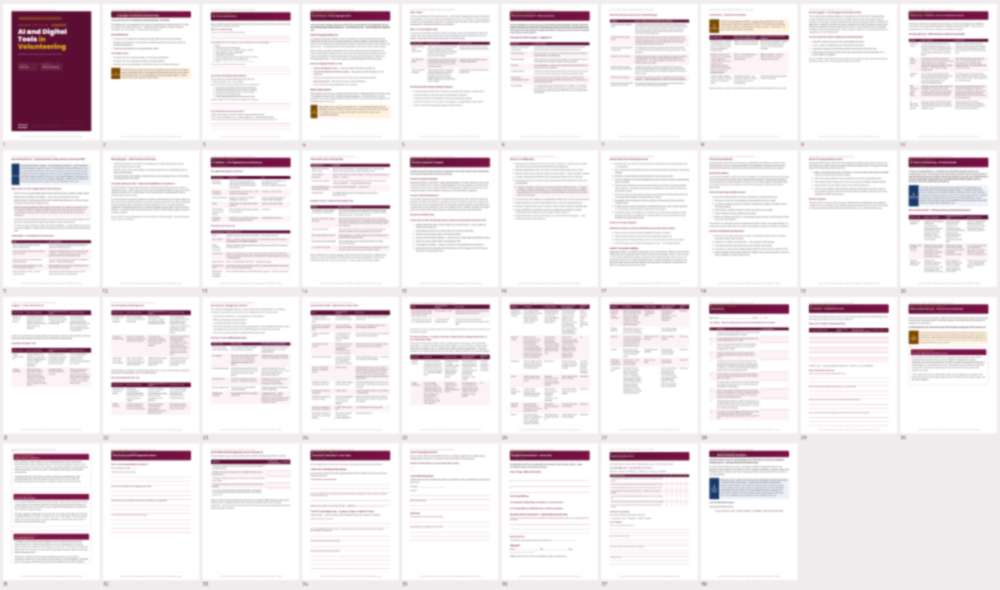 Handouts and worksheets38 pagesFacts, guides, worksheets, scenario cards and templates for participants
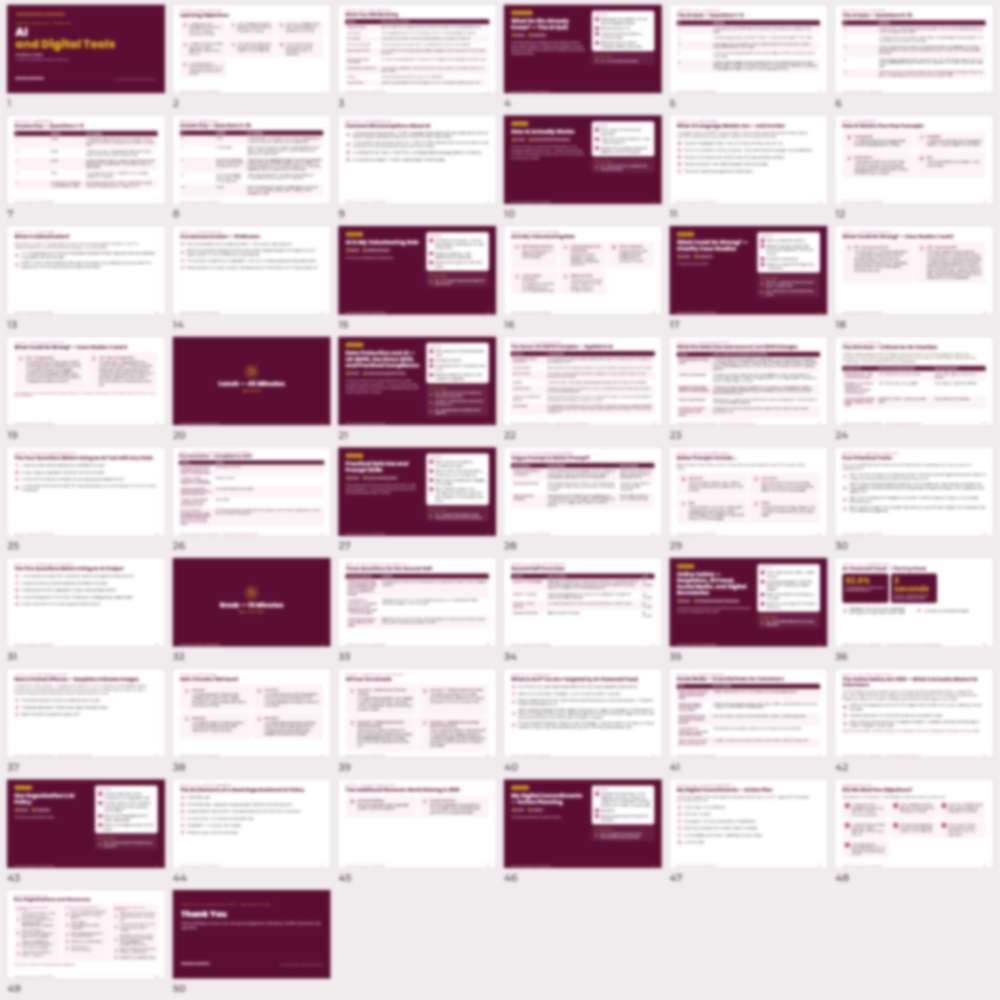 Facilitator slides50 pagesEditable presentation that follows the trainer guide
 Self-study course21 pagesThe same learning for volunteers who can’t attend, with knowledge checks
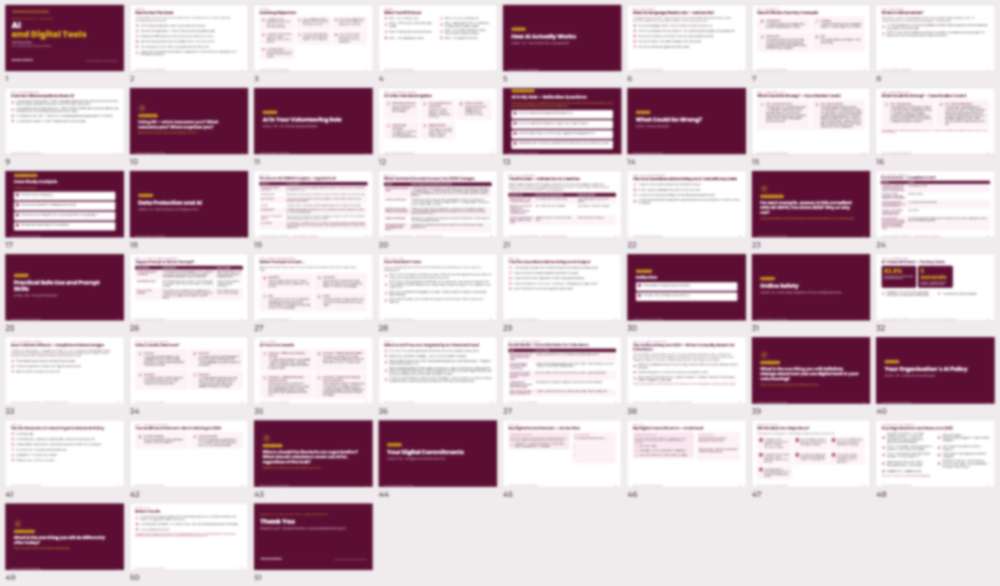 Self-study slides51 pagesThe self-study course as slides, on any screen
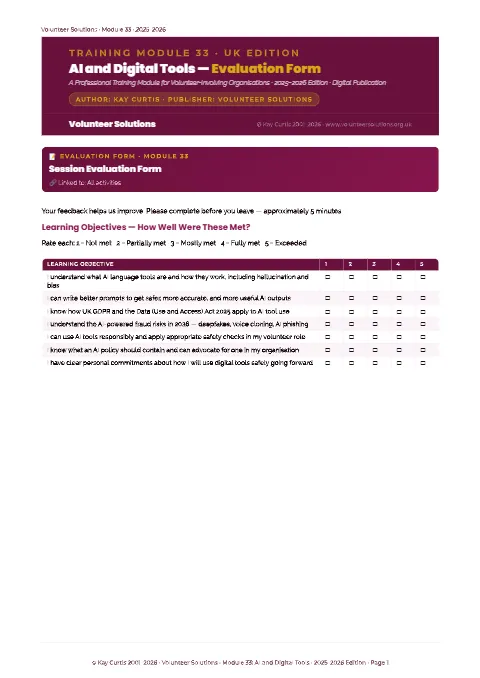 Evaluation form2 pagesParticipant feedback for your records and funders
Previews are shown at low resolution. The full files come with your plan or single purchase.
Deliver it yourselves, in-house
Everything your team needs to run this session without an external trainer: a scripted trainer guide, editable PowerPoint slides you can adapt with your own examples, the whole module in your logo and colours, and handouts ready to print. Kept up to date when the law or guidance changes, and it builds your team’s skills and confidence as they use it.
Why AI and digital tools training matters for volunteers and UK charities in 2026.
Module 33: AI and Digital Tools is a full-day, trainer-led session for volunteers, coordinators and trustees in UK organisations. It covers how AI works, safe and effective use, data protection, online safety and fraud, and organisational AI policy. It is designed for complete beginners and confident digital users in the same room.
AI use in charities has grown faster than the rules around it. The Charity Digital Skills Report 2026, cited in the training module, found that 79% of UK charities are using AI but 51% have no AI policy. The training module treats not using AI as a valid choice: the aim is informed decisions and human review, not adoption for its own sake.
The legal content is awareness-level, not legal advice. It covers UK GDPR and the Data Protection Act 2018, the Data (Use and Access) Act 2025, including the new rules on automated decision-making and the offence of creating non-consensual intimate deepfake images, the Equality Act 2010 and AI bias, and the Online Safety Act 2023. It also draws on guidance from the Information Commission, the Charity Commission, the National Cyber Security Centre and the Fundraising Regulator.
Participants leave with simple checks to run before using any AI tool or AI output, a framework for their organisation's AI policy, and their own commitments about using digital tools safely.
Content last reviewed: November 2026. Written by Kay Curtis, 30+ years’ UK voluntary-sector experience.
Questions
Do participants need to be confident with technology?
No. No technical knowledge is assumed. The session is designed for complete beginners and confident digital users in the same room, and it makes clear that choosing not to use AI is always a valid choice.
What if some participants do not have a device on the day?
The hands-on activity still works. The trainer guide asks you to prepare printed examples of AI outputs in advance and to pair people up, so nobody is left out or singled out.
Does it recommend particular AI tools?
The handouts describe types of tool, such as general assistants, meeting notetakers and design tools, with questions to ask before using each one. Named products, prices and charity offers are kept in one dated table at the back of the AI tools guide, so trainers can check them before each delivery.
Can it help us write an AI policy?
Yes. Activity 7 uses an AI policy framework template with 13 sections, including permitted and prohibited uses, data protection, human review, meetings and AI notetakers, verification and payments, and young volunteers. The principles groups draft can form the basis of a first draft for your board or senior leadership.
How current is the legal content?
It is accurate as at 17 November 2026 and covers UK GDPR and the Data Protection Act 2018, the Data (Use and Access) Act 2025, the Equality Act 2010 and the Online Safety Act 2023 at awareness level. AI law and guidance change quickly, so the trainer guide asks trainers to check for updates from the Information Commission before each delivery.
Often used with
Try the platform free for 14 days
Try the main tools with up to 2 people. If you decide it is not for you, that is fine.
Not ready yet? Get free resources first