Training library · Training module
Module 9
Confidentiality Training for Volunteers
Confidentiality training module for volunteers. Covers what confidentiality means, working within your policy, UK GDPR and data protection, digital confidentiality, when confidentiality must be broken, and safeguarding children and adults at risk.
Also available: Managing Confidentiality: Self-Study Workbook
Overview
Breaches of confidentiality can harm the people your organisation supports and damage trust in the organisation. This training module helps volunteers understand what confidentiality means in practice and how to work within your own confidentiality policy. Through scenario cards, dilemmas and case studies, participants look at information sharing and types of breach, digital confidentiality (messaging apps, social media, email and AI tools), what to keep and what to share, and when confidentiality must be broken. It includes awareness-level input on UK GDPR and the Data Protection Act 2018, and on safeguarding children and adults at risk. Participants finish with a personal confidentiality checklist. The module is easy to tailor to your organisation's own policy.
What participants will learn
By the end of this session participants will:
- have explored what confidentiality means in a volunteering context
- be familiar with their organisation's confidentiality policy and able to work within it
- have an awareness-level understanding of the key laws: UK GDPR, the Data Protection Act 2018, safeguarding legislation and the Worker Protection Act 2023
- have applied the principles of confidentiality to realistic volunteering scenarios, including digital situations
- have discussed what confidentiality means for service users, volunteers and the organisation
- have written a personal confidentiality checklist
- have shown an awareness of safeguarding for both children and adults at risk within their volunteering role
What’s included
- Trainer guide with session timetable, timed activities and trainer notes
- Facilitator slides (editable PowerPoint) with speaker notes
- 9 handouts (H1 to H9)
- 2 worksheets (W1 Policy Questionnaire, W2 My Confidentiality Checklist)
- Scenario cards: 6 situation cards, 4 digital confidentiality cards, 11 dilemma cards and 3 case study cards
- 12 extension activities
- Self-study course and self-study slides for individual learners
- Evaluation form
What’s inside
Every page of every part, zoomed out so you can see the scale and layout: 257 pages in all.
 Trainer guide114 pagesHow to run the session: preparation, timings, what to say, activities and trainer hints
 Handouts and worksheets34 pagesFacts, guides, worksheets, scenario cards and templates for participants
 Facilitator slides13 pagesEditable presentation that follows the trainer guide
 Self-study course34 pagesThe same learning for volunteers who can’t attend, with knowledge checks
 Self-study slides60 pagesThe self-study course as slides, on any screen
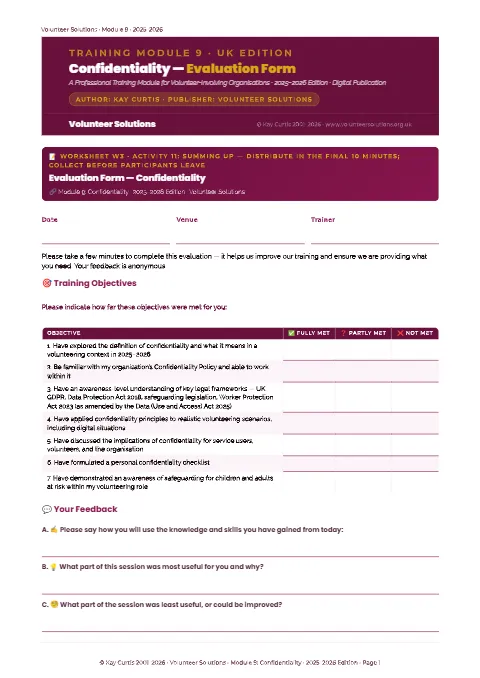 Evaluation form2 pagesParticipant feedback for your records and funders
Previews are shown at low resolution. The full files come with your plan or single purchase.
Deliver it yourselves, in-house
Everything your team needs to run this session without an external trainer: a scripted trainer guide, editable PowerPoint slides you can adapt with your own examples, the whole module in your logo and colours, and handouts ready to print. Kept up to date when the law or guidance changes, and it builds your team’s skills and confidence as they use it.
Why confidentiality training matters for every UK charity volunteer in 2026.
Module 9: Confidentiality is a trainer-led, awareness-level session for volunteers in any role. It covers what confidentiality means, working within your organisation's policy, everyday information sharing, digital confidentiality, and the situations where confidentiality must be broken.
Confidentiality matters to every volunteer: anyone with a mobile phone, anyone who takes notes, anyone who knows a service user's name. UK GDPR and the Data Protection Act 2018 apply to volunteer-involving organisations as they do to any other, and the Information Commission can act on breaches. Messaging apps, social media, shared email and AI tools have made accidental breaches easier than ever.
Volunteers also need to know when confidentiality cannot be kept. Where a child or an adult at risk may be at risk of harm, the information must be passed on through the right route. The module includes a decision guide on when to break confidentiality and handouts on child protection and on adult safeguarding under the Care Act 2014.
Participants finish with a personal confidentiality checklist they can use in their role.
Content last reviewed: April 2026. Written by Kay Curtis, 30+ years’ UK voluntary-sector experience.
Questions
Is this module about UK GDPR specifically or wider confidentiality?
Both. It covers what confidentiality means in a volunteering role, working within your organisation's policy, and awareness-level input on UK GDPR and the Data Protection Act 2018, including a plain guide to UK GDPR for volunteers and a handout on digital confidentiality.
Does it cover when confidentiality MUST be broken?
Yes. Activity 4 uses 11 dilemma cards to test the policy, and H8 is a decision guide on when confidentiality must be broken. The safeguarding section covers concerns about children and adults at risk, including what to do if someone is in immediate danger.
How current is the legal content?
The module reflects UK GDPR, the Data Protection Act 2018 and the changes made by the Data (Use and Access) Act 2025, Information Commission guidance, and current safeguarding frameworks for children and adults at risk. It is reviewed every year and updated when the law or guidance changes.
Is this for advice and befriending volunteers, or for all volunteers?
All volunteers. It is written for anyone who may come across personal information, and is most important for roles with personal contact with service users. Trainers can select or adapt activities to suit the group, so you can give a lighter session to volunteers with little contact with personal information.
Is it better to buy this module or a platform plan?
Confidentiality training works best alongside safeguarding, working safely, and the wider volunteer-management training. If confidentiality is your only training need, the £50 single module works. For full coordinator and volunteer training, the platform, from £295 a year, includes all 57 resources and the tools to run your volunteers, and pays for itself after six modules.
Often used with
Try the platform free for 14 days
Try the main tools with up to 2 people. If you decide it is not for you, that is fine.
Not ready yet? Get free resources first