Training library · Training module
Module 23
Supporting Volunteers with Extra Needs
Organisations increasingly need to show they are willing and able to involve people with extra support needs as volunteers. This session will make them think about ways to involve and support people with extra support needs as volunteers.
Overview
This training module helps anyone who recruits, supports or manages volunteers to include people with extra support needs, including hidden, fluctuating and temporary needs. Participants identify the range of support needs, reflect privately on their own concerns, and use support need cards to explore the barriers volunteers face at recruitment, training and beyond. They plan practical, proportionate ways to reduce those barriers and practise sharing information about support needs appropriately and within UK GDPR. A short trainer presentation covers the Equality Act 2010 and reasonable adjustments and the Worker Protection Act 2023. The session then looks at positive risk-taking rather than exclusion, accessible digital and hybrid volunteering, and the benefits of an inclusive volunteer team.
What participants will learn
By the end of the session participants will:
- have identified the wide range of extra support needs volunteers may have, including hidden, temporary and fluctuating needs
- recognise the barriers volunteers with support needs face at recruitment, during training and throughout their involvement
- have explored practical, proportionate ways to reduce those barriers
- have discussed how to share information about volunteers' support needs appropriately and within UK GDPR
- be aware of the Equality Act 2010, including the definition of disability and the duty to make reasonable adjustments
- understand what the Worker Protection Act 2023 means for volunteer-involving organisations
- have identified potential hazards and how to manage risk through positive risk-taking rather than exclusion
- understand the benefits of a diverse and inclusive volunteer base
- have considered how to make digital and hybrid volunteering accessible
What’s included
- Trainer guide with session timetable, timed activities and trainer notes
- Facilitator slides (editable PowerPoint) with speaker notes
- 8 handouts, including a summary of support needs, a checklist for reducing barriers, plain guides to the Equality Act 2010 and the Worker Protection Act 2023, and a communication guide by support need
- Information-sharing situation worksheets (W1) and an anonymous personal anxiety card (W2)
- 12 support need cards (SN1)
- 12 extension activities
- Self-study course and self-study slides for individual learners
- Evaluation form (W3)
What’s inside
Every page of every part, zoomed out so you can see the scale and layout: 226 pages in all.
 Trainer guide103 pagesHow to run the session: preparation, timings, what to say, activities and trainer hints
 Handouts and worksheets30 pagesFacts, guides, worksheets, scenario cards and templates for participants
 Facilitator slides11 pagesEditable presentation that follows the trainer guide
 Self-study course24 pagesThe same learning for volunteers who can’t attend, with knowledge checks
 Self-study slides56 pagesThe self-study course as slides, on any screen
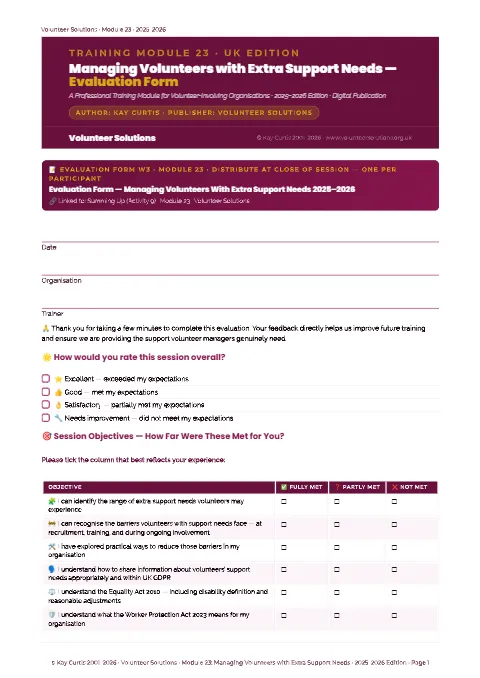 Evaluation form2 pagesParticipant feedback for your records and funders
Previews are shown at low resolution. The full files come with your plan or single purchase.
Deliver it yourselves, in-house
Everything your team needs to run this session without an external trainer: a scripted trainer guide, editable PowerPoint slides you can adapt with your own examples, the whole module in your logo and colours, and handouts ready to print. Kept up to date when the law or guidance changes, and it builds your team’s skills and confidence as they use it.
Why coordinators need training on managing volunteers with extra support needs in 2026.
Module 23: Managing Volunteers with Extra Support Needs is a half-day trainer-led session for volunteer managers, coordinators, staff and trustees who want volunteering to be open to people with a wide range of support needs, including learning disabilities, neurodivergence, mental health needs, physical disabilities and sensory impairments.
Many support needs are hidden, temporary or fluctuating. The module helps participants recognise the barriers volunteers face and find practical, proportionate ways to remove them, so that inclusion works in practice and not just on paper.
The legal input is awareness-level: the Equality Act 2010 and the duty to make reasonable adjustments, the Worker Protection Act 2023, UK GDPR when sharing information about support needs, and brief pointers to the Care Act 2014 and the Mental Capacity Act 2005.
Participants leave ready to use positive risk-taking rather than blanket exclusion, and reassured that inclusion is achievable and a shared responsibility. It pairs well with Module 10 (Diversity).
Content last reviewed: April 2026. Written by Kay Curtis, 30+ years’ UK voluntary-sector experience.
Questions
Which support needs does it cover?
The module covers a wide range of support needs, including learning disabilities, neurodivergence such as autism and ADHD, mental health needs, physical disabilities and sensory impairments, as well as hidden, temporary and fluctuating needs. Support need cards are used to explore barriers and adjustments, and an extension activity uses a communication guide organised by support need.
How does this differ from Module 10 (Diversity)?
Module 10 covers diversity and inclusion broadly — the principles, the law, and inclusive practice across all nine protected characteristics. Module 23 focuses specifically on managing volunteers with extra support needs — particularly disability and neurodivergence with reasonable adjustments at the centre. The two work together.
Does it cover the Mental Capacity Act?
Only briefly. The legal summary notes the Mental Capacity Act 2005 principles of presuming capacity and acting in a person's best interests, for awareness. The module does not train coordinators to assess capacity, which is a specialist task.
Is this about volunteers with support needs, or beneficiaries with support needs?
This module is about supporting volunteers with extra support needs — making the volunteer role accessible. For training on working with beneficiaries who have support needs, that content sits within role-specific modules (Module 11 Befriending, Module 22 Mentoring) and safeguarding (Module 16). The two angles are different and require different training.
Is it better to buy this module or a platform plan?
Extra support needs training pairs naturally with Module 10 (Diversity), Module 16 (Adult Protection), and Module 1 (Recruiting Volunteers). If extra support needs is your only training need, the single module works. For comprehensive inclusive coordinator training, the platform (from £295 a year, with all 55 resources and the tools to run your volunteers) pays for itself after six modules.
Often used with
Try the platform free for 14 days
Try the main tools with up to 2 people. If you decide it is not for you, that is fine.
Not ready yet? Get free resources first