Training library · Training module
Module 10
Diversity Training for Volunteers (EDI)
Equality, diversity and inclusion training module for volunteers. Covers the Equality Act 2010 and the nine protected characteristics, harassment and the Worker Protection Act 2023, how organisations exclude people, and what volunteers can do to support inclusion.
Also available: Being Diverse: Self-Study Diversity Workbook · Diversity & Inclusion Toolkit for Charities
Overview
Volunteers are often the first people service users and the public meet, so they have a real part to play in making an organisation welcoming to everyone. This training module gives volunteers a clear overview of the Equality Act 2010, the nine protected characteristics and the four types of prohibited conduct, and the duty to prevent sexual harassment under the Worker Protection Act 2023. Participants look at who tends to be excluded and how exclusion happens, directly, indirectly, structurally and through digital barriers. Using case study, incident and scenario cards, they practise responding to discrimination and exclusion, discuss the benefits of inclusive practice, and leave with personal actions to support inclusion in their role. Intersectionality, neurodiversity and psychological safety are also covered.
What participants will learn
By the end of the session participants will:
- have a clear overview of the legal framework for equality and inclusion, including the Equality Act 2010 and the Worker Protection Act 2023
- understand the nine protected characteristics and the four types of prohibited conduct: direct discrimination, indirect discrimination, harassment and victimisation
- understand what harassment means in law and the duty on organisations to prevent it
- have considered who tends to be excluded from organisations, as volunteers and as service users, and why
- have explored how organisations exclude people: directly, indirectly, structurally and through digital barriers
- have practised responding to real scenarios involving discrimination and exclusion
- have discussed the practical benefits of diversity and inclusive practice
- have identified personal actions to support greater inclusion in their role
What’s included
- Trainer guide with session timetable, timed activities and trainer notes
- Facilitator slides (editable PowerPoint) with speaker notes
- 8 handouts (H1 to H8), including a protected characteristics reference card
- Organisation diversity reflection worksheet (W1)
- 3 case study cards, 3 incident cards and 6 situation scenario cards
- 5 extension activities and a 75 to 90 minute extension session
- Self-study course and self-study slides for individual learners
- Evaluation form
What’s inside
Every page of every part, zoomed out so you can see the scale and layout: 214 pages in all.
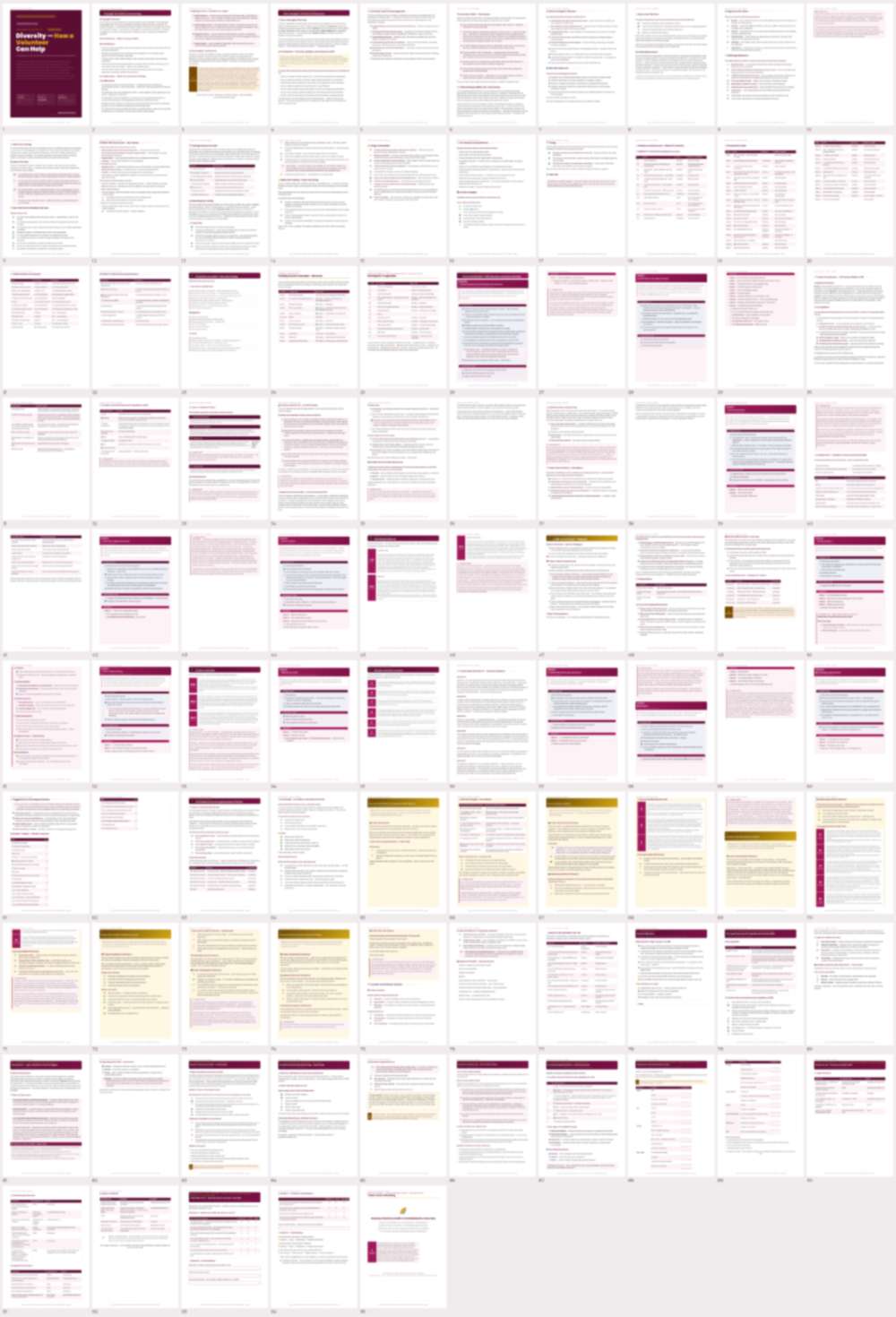 Trainer guide95 pagesHow to run the session: preparation, timings, what to say, activities and trainer hints
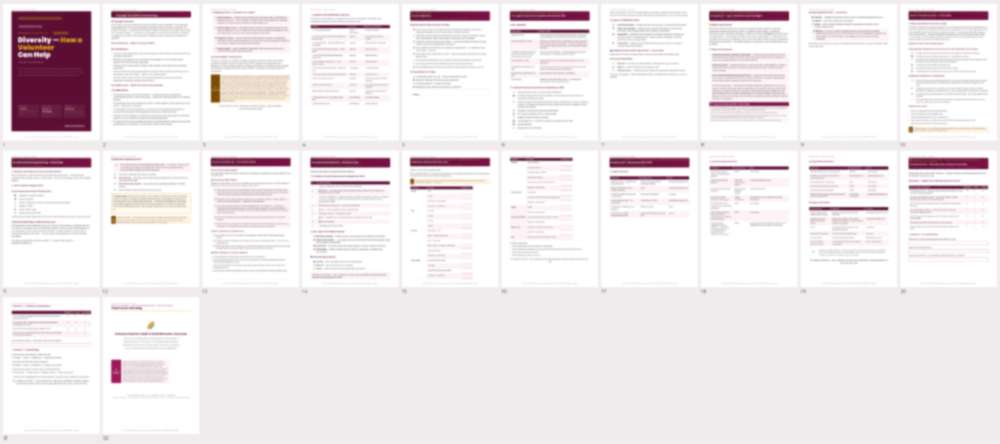 Handouts and worksheets22 pagesFacts, guides, worksheets, scenario cards and templates for participants
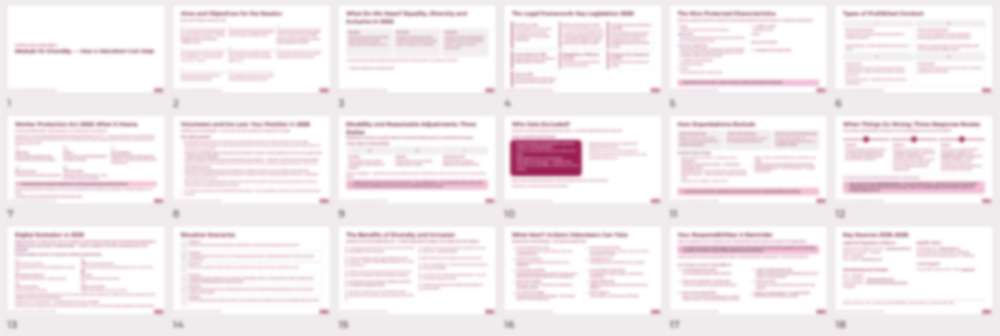 Facilitator slides18 pagesEditable presentation that follows the trainer guide
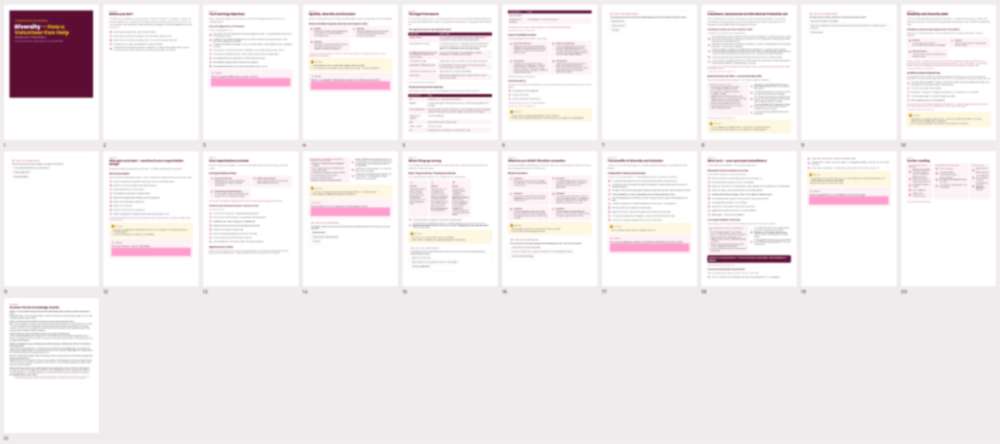 Self-study course21 pagesThe same learning for volunteers who can’t attend, with knowledge checks
 Self-study slides56 pagesThe self-study course as slides, on any screen
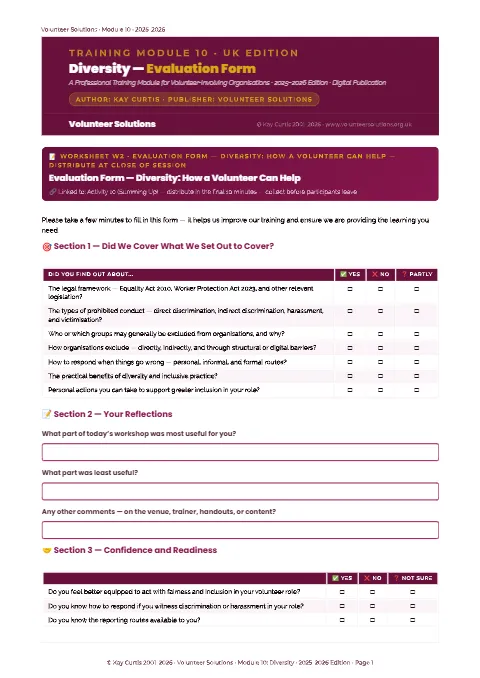 Evaluation form2 pagesParticipant feedback for your records and funders
Previews are shown at low resolution. The full files come with your plan or single purchase.
Deliver it yourselves, in-house
Everything your team needs to run this session without an external trainer: a scripted trainer guide, editable PowerPoint slides you can adapt with your own examples, the whole module in your logo and colours, and handouts ready to print. Kept up to date when the law or guidance changes, and it builds your team’s skills and confidence as they use it.
Why diversity training matters more for UK volunteer-involving charities in 2026 than ever.
Module 10: Diversity — How a Volunteer Can Help is a trainer-led session of about three and a half hours for volunteers and the staff who support them. It covers the Equality Act 2010, the nine protected characteristics, harassment and the duty to prevent it, how exclusion happens, and practical inclusive action, with an optional extension session.
The Equality Act 2010 applies to volunteer recruitment, volunteer management and service delivery. The nine protected characteristics are age, disability, gender reassignment, marriage and civil partnership, pregnancy and maternity, race, religion or belief, sex, and sexual orientation. The Worker Protection Act 2023, in force from October 2024, requires employers to take reasonable steps to prevent sexual harassment of workers, raised to all reasonable steps from 30 October 2026 under the Employment Rights Act 2025. The module explains what this means for volunteer-involving organisations.
The module also covers intersectionality, neurodiversity, digital exclusion and psychological safety, and uses case study, incident and scenario cards so that participants practise what to do when things go wrong.
For individual learning, pair it with Self Study Series 6: Being Diverse, and with Toolkit 4: Towards Diversity for coordinators.
Content last reviewed: April 2026. Written by Kay Curtis, 30+ years’ UK voluntary-sector experience.
Questions
Is this for volunteers, coordinators, or both?
Both. It is written for volunteers new to equality and inclusion and for staff, trustees and managers who support volunteers or review their organisation's approach. Trainers can select and adapt activities to suit the group.
Does it cover the nine protected characteristics in depth?
Yes. The module covers each of the nine protected characteristics — age, disability, gender reassignment, marriage and civil partnership, pregnancy and maternity, race, religion or belief, sex, and sexual orientation — in plain-English form, with practical guidance on what they mean in volunteer settings.
Does it cover reasonable adjustments for disabled volunteers?
Yes, as part of the legal framework. Activity 1 explains disability and the three duties to make reasonable adjustments under the Equality Act 2010. For more on supporting volunteers with additional needs, see Module 23: Managing Volunteers with Extra Support Needs.
How does this differ from Module 23?
Module 10 covers diversity and inclusion broadly — the principles, the law, and inclusive practice across all nine protected characteristics. Module 23 focuses specifically on managing volunteers with additional support needs (largely disability and neurodiversity-focused, with reasonable adjustments at the centre). The two work together.
Is it better to buy this module or a platform plan?
Diversity training underpins recruitment, retention, customer care, and supervision. If equality and inclusion is your only training need, the single module works. For comprehensive training, the platform (from £295 a year, with all 55 resources and the tools to run your volunteers) pays for itself after six modules.
Often used with
Try the platform free for 14 days
Try the main tools with up to 2 people. If you decide it is not for you, that is fine.
Not ready yet? Get free resources first