Training library · Training module
Module 14
Customer Care Training for Charity Volunteers
A practical session of under three hours that helps volunteers and staff in charity shops, support groups and every voluntary organisation give good customer care, respond calmly to challenging situations and know their rights.
Also available: Customer Service for Volunteers: Self-Study Workbook
Overview
Charity shops, support groups and in fact all voluntary organisations have customers. This training module helps volunteers and staff give the best possible service. Participants identify who their customers are (not only service users but also volunteers, funders, partners and digital contacts), explore what good customer care means, and look at what upsets customers. Using customer type cards and scenario cards, they explore what drives challenging behaviour, including trauma, unmet need, neurodivergence and financial pressure, and practise practical, proportionate responses. The session also covers fairness and not rewarding difficult behaviour at the expense of quieter customers, the legal framework for customer-facing work (the Equality Act 2010, the Worker Protection Act 2023, the Health and Safety at Work Act 1974 and Charity Commission guidance CC47 on complaints), digital customer care, and when to pause, escalate and seek support. Participants finish with ideas for improving customer care in their organisation and a personal action plan.
What participants will learn
By the end of the session participants will:
- recognise who their customers are, beyond service users
- have explored what good customer care means in a voluntary organisation
- have identified common causes of customer frustration and distress
- understand what can drive challenging behaviour, including trauma, unmet need, neurodivergence and financial pressure
- have reflected on how their own communication style affects customers
- have practised practical responses to challenging situations
- have an awareness of the legal framework for customer-facing work, including the Equality Act 2010, the Worker Protection Act 2023 and Charity Commission guidance CC47
- have reflected on fairness and consistency between customers
- have contributed ideas for improving customer care in their organisation
- know when to pause, escalate and seek support
What’s included
- Trainer guide with session timetable, timed activities and trainer notes
- Facilitator slides (editable PowerPoint) with speaker notes
- 10 handouts (H1 to H10)
- 4 worksheets (W1 to W4), including a customer care action plan
- 8 challenging customer type cards and 6 situation scenario cards
- 3 extension activities
- Self-study course and self-study slides for individual learners
- Evaluation form
What’s inside
Every page of every part, zoomed out so you can see the scale and layout: 242 pages in all.
 Trainer guide104 pagesHow to run the session: preparation, timings, what to say, activities and trainer hints
 Handouts and worksheets37 pagesFacts, guides, worksheets, scenario cards and templates for participants
 Facilitator slides13 pagesEditable presentation that follows the trainer guide
 Self-study course30 pagesThe same learning for volunteers who can’t attend, with knowledge checks
 Self-study slides56 pagesThe self-study course as slides, on any screen
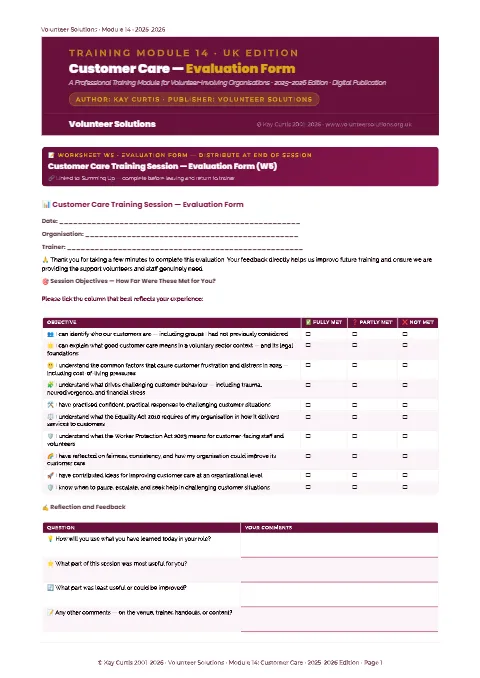 Evaluation form2 pagesParticipant feedback for your records and funders
Previews are shown at low resolution. The full files come with your plan or single purchase.
Deliver it yourselves, in-house
Everything your team needs to run this session without an external trainer: a scripted trainer guide, editable PowerPoint slides you can adapt with your own examples, the whole module in your logo and colours, and handouts ready to print. Kept up to date when the law or guidance changes, and it builds your team’s skills and confidence as they use it.
Why customer care training matters for UK charity volunteers in public-facing roles.
Module 14: Customer Care is a trainer-led session of about 2.5 hours for volunteers and staff in any public-facing role, from charity shops and reception desks to support groups and events. Every interaction your volunteers have with the public represents your organisation.
The module takes a broad view of who customers are and what good care looks like, and gives volunteers practical, proportionate ways to respond when people are frustrated, distressed or challenging, with an understanding of what often lies behind that behaviour.
Customer care also has a legal side. The Equality Act 2010 applies to service delivery, including reasonable adjustments for disabled customers. The Worker Protection Act 2023 requires employers to take reasonable steps to prevent sexual harassment of staff, including by customers, raised to all reasonable steps from 30 October 2026. Most volunteers are not covered by that duty, so the module recommends extending the same protection to volunteers as good practice. No volunteer should be expected to put up with abusive or threatening behaviour.
For individual learning, pair it with Self Study Series 5: Delivering Great Customer Service, and for shop teams with Module 31: Managing Charity Shop Volunteers.
Content last reviewed: April 2026. Written by Kay Curtis, 30+ years’ UK voluntary-sector experience.
Questions
Is this module just for charity-shop volunteers?
No. It works for any role where volunteers deal with the public or with service users, including charity shops, support groups, reception and events. For managing shop teams, see Module 31: Managing Charity Shop Volunteers.
How is this different from the difficult-behaviour modules?
Customer care covers everyday service as well as challenging moments, and helps volunteers understand and respond to difficult customer behaviour. Module 8: Dealing with Difficult Behaviour goes further into difficult and aggressive behaviour, and Module 17: Managing Difficult Volunteer Situations is for those who manage volunteers when problems arise.
Does it cover dealing with abusive members of the public?
Yes, at awareness level. The module makes clear that no volunteer or member of staff should have to put up with abusive, threatening or harassing behaviour, covers practical responses and when to pause, escalate and seek help, and explains the Worker Protection Act 2023 and why good practice is to extend its protection to volunteers. For more on aggression and personal safety, pair it with Module 8: Dealing with Difficult Behaviour and Module 5: Working Safely.
Is it inclusive of disabled customers and beneficiaries?
Yes. The module covers inclusive service delivery including reasonable adjustments for disabled customers, communication accessibility, and the Equality Act 2010 obligations that apply to service delivery.
Is it better to buy this module or a platform plan?
Customer care works best alongside induction, working safely, diversity, and the difficult-behaviour modules. If customer care is your only training need, the single module works. For a complete front-line volunteer training programme, the platform (from £295 a year, with all 55 resources and the tools to run your volunteers) pays for itself after six modules.
Often used with
Try the platform free for 14 days
Try the main tools with up to 2 people. If you decide it is not for you, that is fine.
Not ready yet? Get free resources first